The response to the CAA Consultation on Electronic Conspicuity CAP3268 needs to be completed before September 22 2026.
This guides you through the process so that you can make your responses in your own words with your own thoughts.
The CAA Consultation on Electronic Conspicuity is outlined in CAP3268 which can be downloaded from the CAA website .
The CAA consultation asks 13 questions about the proposed Electronic Conspicuity Mandate. Before answering them, it may be useful to keep the following wider issues in mind.
The objective of improving electronic conspicuity and reducing the risk of collision is widely supported by the aviation public. The important question is whether the proposed architecture to be mandated is the safest, most proportionate, most workable across all use cases, most reliable and most future-proof way of achieving the stated CAA objectives.
The CAA has not fully described how drones will effectively communicate with other drones and light aircraft when they will be operating of different frequencies. These are 978MHz for drones and 1090MHz for manned aircraft. 978MHz ground infrastructure is identified but not when it will be implemented, nor who will be paying for its national deployment.
The CAA has however confirmed that the mandate is initially for air to air sense and avoid only. The assumption being that if everyone is on the same frequency then all manned aircraft will be electronically detectable at all times. This ignores airframe and occupant obscuration, specific aircraft use cases and the ability to install and operate the mandated equipment comprising transponders and transceivers (CAP1391 devices) across all airframes.
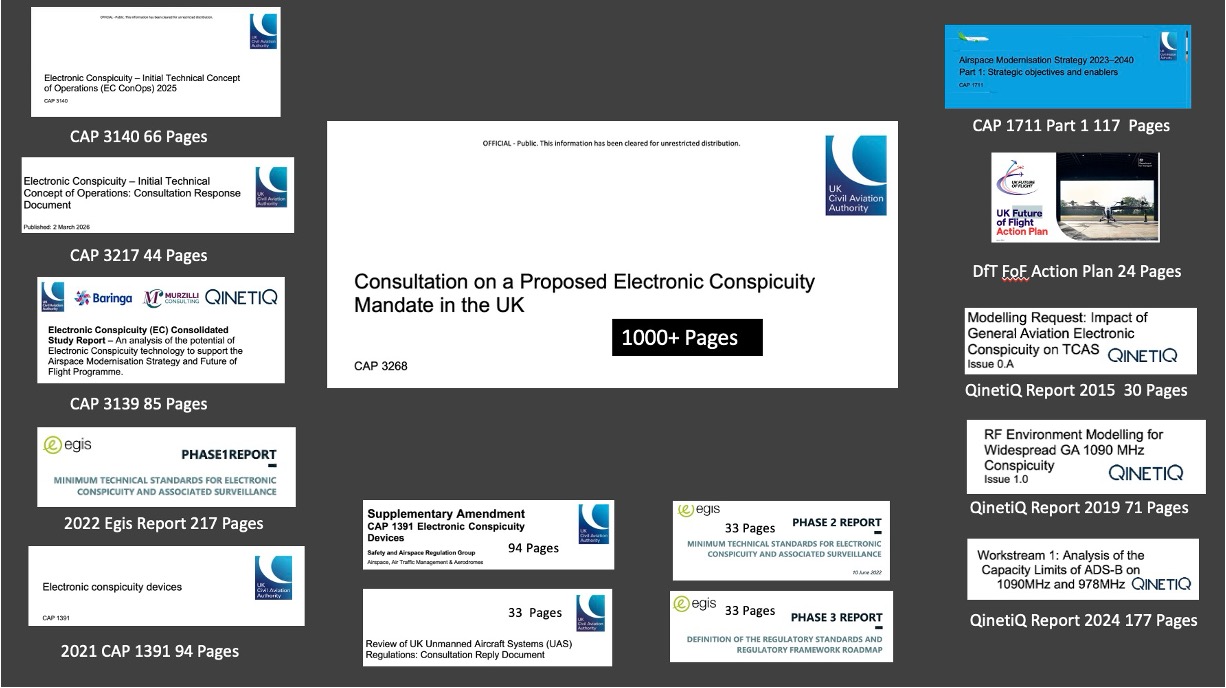
To help you make an informed opinion several documents and studies have been published over the past 11 years. These include the following publications
Documents Published to support answering the EC mandate 2026.
It is unrealistic to expect you to read all of these so others have done it for you and bring out the following points from within the documents and studies. If you want to see what the BGA, BHPA, BMAA, LAA, AFE and other independents say have a look at our other blog on the Pilotaware website
1090 MHz is a safety-critical aviation frequency used by Mode S transponders, ADS-B, Secondary Surveillance Radar (SSR) and TCAS. If too many aircraft use it simultaneously then it becomes overloaded (congested) and becomes unreliable for aviation safety. This is more likely around large airfields such as Heathrow, Gatwick, Luton, Stanstead etc
CAA-commissioned work by QinetiQ in 2015, 2019 and 2024 , together with work by EGIS and Eurocontrol, all identified increasing 1090MHz loading and the need for immediate and continuous monitoring of the frequency to identify and manage frequency congestion when it arises.
QinetiQ identified that a substantial new increased population of 1090MHz transmitting aircraft would endanger the spectrum. The Mandate proposes doing exactly that by adding all manned aircraft onto the spectrum. Before committing virtually all remaining crewed GA to 1090 MHz, it is believed that the modelling be rerun using the actual 1090MHz equipment mix and transmission characteristics now proposed by CAP3268.
Transponders and transceivers are not the same
QinetiQ identified that a 70W Mode S Extended Squitter transponder and a low-power CAP1391 transceiver do not make the same contribution to 1090 MHz loading. The transponder being much higher.
They have different transmitter powers, message rates and operating characteristics. If existing Mode S aircraft are upgraded to ADS-B Out rather than owners purchasing CAP1391 equipment, the resulting spectrum loading will therefore be different from that assumed in earlier modelling. This concentration should be established before the mandate is implemented.
GA is being mandated before the rest of the system
The CAA confirmed in the recent Webinar, that there is currently no fixed implementation date for ANSPs, including NATS, to monitor the mandated GA ADS-B transmissions for ATC management or greater airspace access.
It was also confirmed that there is also no equivalent EC mandate for drones to be introduced at the same time.
If the purpose is eventually to create an integrated system involving GA, drones and air traffic services, should not all parts of the system be ready at the same time? Why should GA be mandated to install and pay for additional EC, that gives no additional benefit, in advance?
One size of EC does not fit every aircraft
Commercial aircraft, GA aeroplanes, helicopters, gliders, microlights, balloons, vintage aircraft, paragliders, hang-gliders and drones all have very different operating environments, risks, power supplies, installation possibilities and equipment costs.
Should they all therefore be required to use essentially the same EC architecture as commercial aviation? Is it not more appropriate to define the required safety, conspicuity and interoperability performance requirements and allow the appropriate technologies to achieve them?
ADS-B out does not automatically provide TCAS interoperability for safety.
Commercial aviation collision-avoidance equipment operates to a substantially higher safety-integrity and certification standard than that proposed for CAP1391 equipment.
A CAP1391 ADS-B transmission should therefore not be assumed to provide the same interoperability with commercial-aircraft equipped TCAS as a certified Mode S transponder. TCAS uses Mode-S transmissions not ADSB (DF18). When considering the safety benefit of the Mandate, pilots should ask: Who will actually receive and use my mandated transmission, what for and when?
FLARM and ADS-L (PilotAware) already provide useful EC
Many GA pilots already voluntarily use PilotAware, FLARM and other regulated but unlicensed, EC systems because they have been developed to provide useful traffic information, predictive algorithms, and interoperability between systems where possible.
These technologies can provide useful air-to-air conspicuity without requiring every aircraft to transmit ADS-B on 1090 MHz.
Should not successful existing EC systems form part of the future architecture where appropriate rather than requiring all manned aircraft to transmit on 1090 MHz?
Is it not more productive to offload GA traffic from the 1090MHz frequency congestion burden rather than add to it?
Europe is developing ADS-L
Europe is developing ADS-L as complementary electronic conspicuity, using multiple technologies for light aviation and other airspace users such as drones and UAV.
ADS-L operates away from 1090 MHz and can therefore provide electronic visibility without adding unnecessary transmissions to the safety-critical 1090 MHz environment.
Should the UK ensure that its mandate remains capable of interoperability with this neighbouring pan European architecture rather than committing to a potentially divergent UK only solution?
Think about the complete system
As you answer the following questions, you may therefore wish to consider not simply:
“Do I support Electronic Conspicuity?” but:
“Will the proposed mandate deliver the safety, interoperability and integration benefits claimed, at proportionate cost, without creating unnecessary 1090 MHz congestion or preventing better technologies being adopted in future?”
The following guide has been produced to assist you on answering the CAA CAP 3268 Mandate questions. They are not the answers – you must provide them in your own words, after considering your position. Do you agree wholeheartedly, somewhat or not at all. This is what the CAA want to know. Your opinion.
Question 1
1. The CAA’s proposal is that the EC Mandate should apply to all civil general air traffic that is not already required to carry and use ADS-B equipment, operating below FL100 in UK sovereign airspace, subject to the exceptions for military and state aircraft and VLOS operations described in this chapter. Do you agree with that proposal?
Do you agree with the proposal answer Yes or No Then state your reasons why.
You may wish to consider the following points in your answer:
Do you support the objective of making aircraft more electronically conspicuous, but question whether this means whether every type of GA aircraft should be required to use 1090 MHz ADS-B?
Is the same solution proportionate for a powered GA aircraft, glider, microlight, balloon, vintage aircraft, paraglider or hang-glider?
If you already use PilotAware, FLARM or another EC system that provides useful traffic awareness, what additional safety benefit will the mandated equipment give you?
If future drone integration is one of the reasons for requiring universal GA conspicuity, should corresponding requirements for drones be introduced at the same time?
Should the CAA mandate a required level of conspicuity, interoperability and safety performance rather than requiring virtually all remaining manned GA use 1090MHz?
With Europe developing ADS-L and existing systems such as FLARM and PilotAware already widely used, should the UK architecture accommodate these technologies?
Before extending 1090 MHz transmissions to virtually the whole remaining GA population, should the CAA demonstrate through updated modelling that the resulting frequency loading is acceptable?
Question 2
2. Do the minimum performance requirements set out in CAP 3140 provide appropriate and workable technical requirements for the EC Mandate?
Provide evidence where technical requirements may affect overall impacts, implementation feasibility, interoperability or operational practicality.
You may wish to consider the following points in your answer:
QinetiQ modelling shows that transponders and CAP1391 devices make different contributions to 1090 MHz loading. Should the predictive modelling be re-run using the equipment mix now likely to result from the mandate?
If you already have a Mode S transponder with a SIL=0 GPS source, what would upgrading to SIL≥1 cost you and what additional safety benefit would you receive for that cost?
In the webinar, the CAA said SIL≥1 is required to ensure UAS detect-and-avoid systems can use your transmission. If part of that requirement is for the benefit of future drone operations, should GA bear the whole cost?
The CAA said further work is still being completed on the real-world range of CAP1391 equipment. Should the technical requirements be finalised before equipment is mandated?
Should the requirements accommodate European ADS-L and other suitable EC technologies rather than committing almost all crewed GA to 1090 MHz?
Question 3
3. CAP 3140’s Position 6 sets out the ADS-B IN receive capability for crewed aircraft should remain a voluntary, operator-led choice rather than a mandatory requirement. Do you agree with this position?
If no, please explain what approach you would propose and why, including the operational and safety implications. Please provide supporting evidence where available.
Do you agree with the proposal answer Yes or No Then state your reasons why.
You may wish to consider the following points in your answer:
If you already voluntarily use PilotAware, FLARM or another EC receiver, does it provide the traffic information and warnings you need, and are they useful?
Should you remain free to choose the receiver and display best suited to your aircraft and type of flying?
If ADS-B IN remains voluntary, should interoperability between different EC systems nevertheless be encouraged so that pilots receive the widest practical traffic picture?
Question 4
4. In which circumstances, if any, could the objectives of an EC Mandate be met through means other than direct carriage of EC equipment by the aircraft?
Please explain how any alternative approach would deliver the objectives of the EC mandate set out in Chapter 3. Please provide evidence on the operational contexts where this might apply.
You may wish to consider the following points in your answer:
Consider why does every type of aircraft have to carry the same equipment? Gliders, balloons, microlights, GA aircraft, commercial aircraft, paragliders and hang-gliders all have different requirements and may need different levels of specification and functionality. Is this possible with the mandated solution?
Could data rebroadcast, mobile networks or air-to-air relays complement direct EC, as is already being demonstrated by developing ADS-L and other EC technologies?
Do these existing systems in your opinion make PilotAware, FLARM, ADS-L and ADS-B users more visible to one another?
Should the CAA accept an alternative if it demonstrably provides the required safety and interoperability, even if it uses a different technology or frequency?
Could a multi-technology approach allow drones and crewed aircraft to see one another while reducing unnecessary additional loading of 1090 MHz?
Question 5
5. The CAA and the Department for Transport are looking at how to balance clear rules with the flexibility needed as technology develops. This includes whether detailed technical requirements for EC equipment should be set out in guidance or other non-legislative documents, rather than in legislation.
Is there anything you think we should take into account when considering this?
You may wish to consider the following points in your answer:
Technology always develops faster than regulation, and the pace of innovation is increasing. Is legislating around a particular technology wise, particularly when 1090 MHz is already mature and fundamental to the commercial aviation safety infrastructure?
Would it be better for legislation to specify the required safety, conspicuity and interoperability performance rather than a particular technology?
Should CAP1391 be updated before it becomes part of a mandatory framework? For example, how long would you expect compulsory equipment so designed to remain useful?
With ADS-L developing in Europe, should UK regulation be flexible enough to accommodate future interoperable technologies across Europe?
Question 6
6. Is there anything you would like us to consider as we develop our oversight and compliance approach to support effective implementation of an EC Mandate across different aircraft categories and operational contexts?
Please provide examples where possible, including any aircraft categories where existing oversight mechanisms may not be appropriate or sufficient, and suggestions for how compliance might be assessed in those cases.
You may wish to consider the following points in your answer:
Is carrying an approved 1090 MHz EC box enough, or should compliance include whether your aircraft can actually be continuously detected in flight, both air-to-air and air-to-ground?
Antenna position, aircraft structure and body shielding can significantly affect portable EC performance. How should this be addressed in a mandatory 1090 MHz environment?
Could existing ground receiver networks help check actual airborne transmission performance?
Could the LAA, BMAA, BGA, BHPA and other existing organisations help support proportionate compliance without creating another expensive regulatory system?
Question 7
7. Do you agree that a single compliance start date, following an adequate transition period, is preferable to a phased approach?
If not, please explain what phased or alternative delivery model you would propose, which categories it should apply to, and why. Please provide supporting evidence.
You may wish to consider the following points in your answer:
The CAA said there is no fixed timetable for ANSPs, including NATS, to use your ADS-B transmission for ATS or airspace access. Should GA therefore be mandated first without knowing when the wider benefits will become available?
There is no equivalent drone mandate planned for the same date. Should the two sides of the intended integration system be introduced together?
The CAA described the GA mandate as the baseline or foundation, with other capabilities coming later. Are you content to pay and equip before those benefits exist?
Should implementation begin only when the specification, equipment, infrastructure and intended users are sufficiently ready?
Would a phased introduction allow actual 1090 MHz loading to be measured before the whole GA fleet is required to equip and transmit?
Question 8
8. Is the proposed transition period of approximately two years achievable across different operations?
Please explain your reasoning and provide supporting evidence. Please include evidence on how quickly operators in your sector could realistically equip, whether sufficient EC equipment and installation capacity would be available, and what transition period would be more appropriate if two years is not sufficient.
If you are a manufacturer or supplier of EC equipment, please provide evidence on your current production capacity, any constraints that could limit supply within this timeframe, and whether compliant equipment could be made available in the quantities needed. If not, please explain what timeframe would be more appropriate and why.
You may wish to consider the following points in your answer:
Should the two-year transition period start before or after the final technical specification is published?
The CAA said manufacturers have been waiting for clear requirements before developing products. Should manufacturers be given sufficient time to develop competing equipment first?
CAP1391 is still to be revised and performance work continues. Would you buy equipment before this work is finalised?
Could a two-year rush reduce product choice, increase prices or overwhelm installers?
Would you be content with a minimal choice of compliant products offering few or no additional operational benefits?
Question 9
9. Is there anything you want to tell us about the availability of compliant EC equipment and the capacity of the installation and maintenance sector to support implementation within the proposed timescales?
If so, please provide specific evidence on equipment availability, installer capacity, lead times, and any other supply chain considerations relevant to your sector.
You may wish to consider the following points in your answer:
How many compliant products could you actually choose from and buy today?
In the webinar, the CAA acknowledged the present limited choice and said it expects manufacturers to develop products once the requirements are clear. Should equipment become compulsory before a competitive market exists?
Should UK manufacturers be given sufficient time after CAP1391 is revised to develop competing products?
If you already have Mode S, PilotAware or FLARM, should upgrading or integrating existing equipment be encouraged rather than unnecessarily replacing it?
If installation is required, will there be sufficient installer and maintenance capacity for the whole GA fleet?
Question 10
10. What costs would the proposed EC Mandate impose on you or the sector you represent?
Please provide quantitative estimates where possible, including equipment purchase, installation, maintenance, training and any operational costs. If you consider that costs would fall on particular groups within your sector, please explain why and provide supporting evidence.
You may wish to consider the following points in your answer:
The CAA confirmed that its proposal includes no Government funding for GA equipage. What will compliance actually cost you, and do you consider that cost proportionate or worth it?
If you already own Mode S and useful EC equipment, will you have to buy or modify additional equipment while continuing to use what you already have?
The CAA said SIL≥1 is required partly for future UAS detect-and-avoid. If commercial drone operations benefit from your mandatory transmission, should they contribute towards the cost?
If you fly perhaps 50 hours a year in a relatively low-value aircraft, is the cost proportionate to the additional safety or operational benefit you receive?
Have you included installation, GPS source, antennas, maintenance and aircraft downtime as well as the purchase price of the equipment?
Question 11
11. What evidence do you have on the likely operational impacts of the proposed EC Mandate?
Please provide data, studies, or operational experience where available.
You may wish to consider the following points in your answer:
The CAA confirmed that the mandate will not initially give you greater access to controlled airspace. What new operational benefit will you receive when it starts?
The CAA said there is no fixed timetable for ANSPs to use your ADS-B transmission for ATS or airspace access. Does that affect its value to you?
With no equivalent drone mandate planned for the same time, how much of the future integration benefit will exist when GA is required to equip?
If you already use PilotAware or FLARM, will the mandated equipment replace it or simply become another system you have to carry and transmit, with little additional benefit?
If you fly to Europe, or have friends who fly to Britain from Europe, will the UK approach make international flying easier or more complicated?
Question 12
12. Are there groups, sectors, aircraft types or regions that would be affected more than others by the proposed EC Mandate, either positively or negatively?
Please explain and provide evidence where possible, including any equality, accessibility or unintended consequences. Please consider both the costs and the benefits when describing differential impacts.
You may wish to consider the following points in your answer:
Is one proposed mandated solution based predominantly on 1090 MHz proportionate for powered aircraft, gliders, microlights, balloons, vintage aircraft, paragliders and hang-gliders?
How significant is the cost to somebody flying perhaps 50 hours a year in a low-value aircraft compared with a commercial operator?
The CAA confirmed that visiting foreign aircraft below FL100 would also have to comply. Could this discourage European pilots from visiting Britain?
If UK and European EC architectures develop differently, could pilots crossing the Channel eventually need additional equipment to remain compliant and interoperable?
Who gains most from universal GA electronic visibility, and who bears most of the cost?
Question 13
13. Based on the evidence available to you, do you consider the CAA’s preferred approach would meet the safety and integration objectives set out in Chapter 3?
Please explain your reasoning and provide supporting evidence. If you consider any aspects of the proposal would not meet those objectives, please identify which aspects and what changes you would propose.
You may wish to consider the following points in your answer:
Having considered the QinetiQ work on 1090 MHz congestion, together with the other available studies, are you satisfied that putting virtually all remaining crewed GA onto that frequency is the best long-term solution?
QinetiQ indicates that EC policy and equipage assumptions may need to be retested as circumstances change. Has CAP3268 changed those assumptions sufficiently that you would expect updated modelling before a mandate?
The CAA described the proposal as an air-to-air baseline or foundation, while confirming that there is no fixed timetable for ANSP reception and use. Is the complete system sufficiently ready to mandate?
If an equivalent drone mandate is not being introduced at the same time, yet future drone detect-and-avoid is part of the justification for SIL≥1, should GA be required to equip first and bear the whole cost?
With Europe developing ADS-L, should the UK commit now to an architecture that could potentially diverge from future European EC?
Would a mandate specifying the required safety, conspicuity and interoperability performance, while allowing suitable technologies and frequencies to meet those requirements, achieve the CAA’s objectives more effectively?
Would it be beneficial to keep appropriate lower-risk GA traffic away from 1090 MHz where other technologies can provide the required conspicuity, thereby preserving capacity on the safety-critical aviation frequency?